Audio Bridge
MORE HARDWARE. MORE TRACKS. ONE SESSION.

Multitrack your USB gear.
Right inside your DAW.

Add multitrack USB audio to the DAW setup you already use.
Record your synths and audio devices on separate tracks. Send audio back over USB.
Your main interface — and everything connected to it — stays in place.

One desktop app + Receive & Send plugins. No Aggregate Device required.

14-day trial · No credit card · macOS · VST3 + AU
THE AUDIO BRIDGE DESKTOP APPRECEIVE ↔ SEND
Audio Bridge● CONNECTED
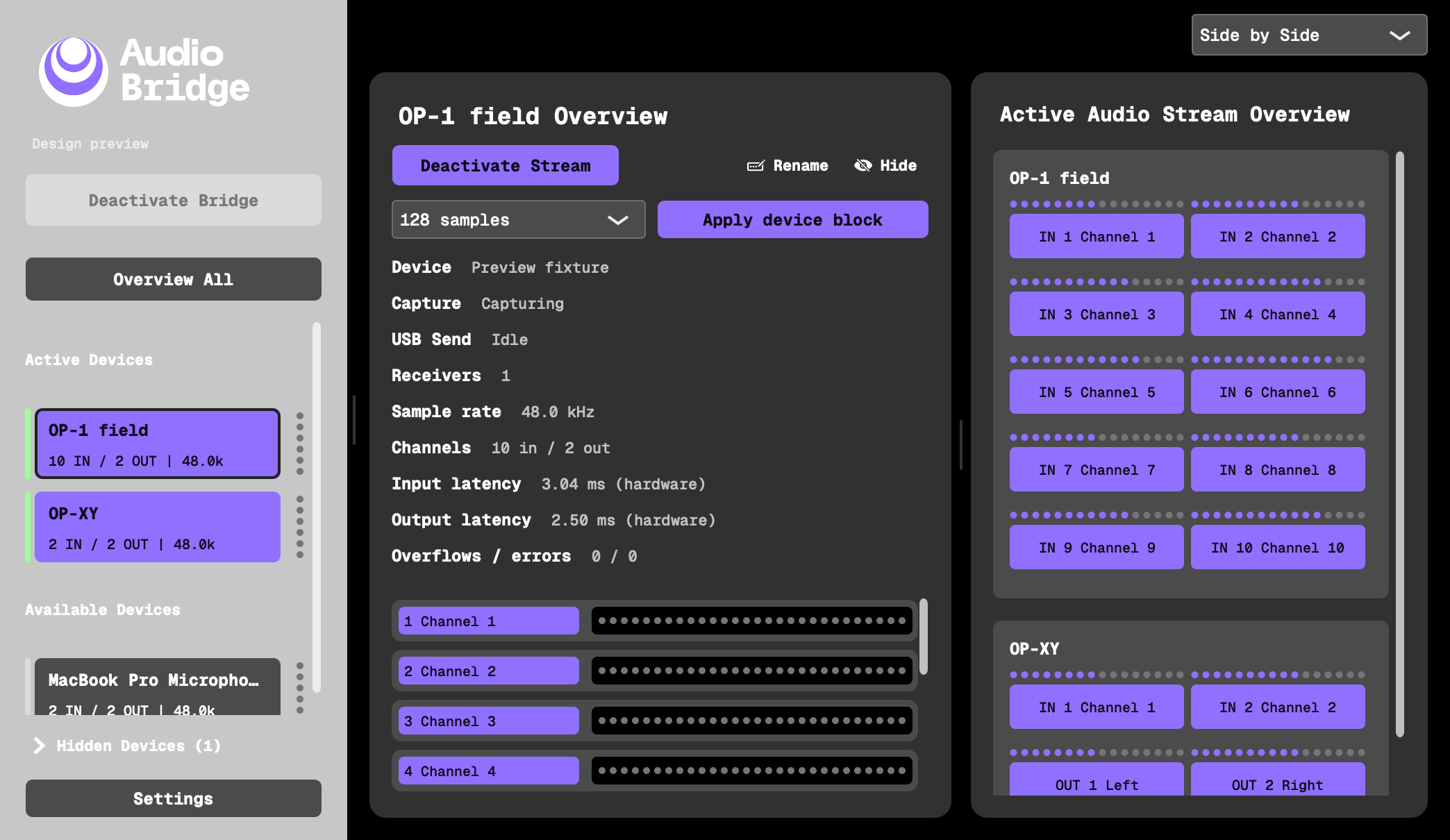
Audio Bridge desktop app showing USB devices, audio channels and active streams
USB multitracking. Alongside your existing setup.
TWO AUDIO PATHS. ONE DAW SESSION.

More USB tracks.
Same connected studio.

YOUR EXISTING AUDIO DEVICE

Main audio
interface

Mic & line inputs
Speakers & headphones

STAYS SELECTED IN YOUR DAW
INPUTOUTPUT
YOUR RECORDING SESSION

Your DAW

AUDIO SETTINGS

Input Main interface

Output Main interface

Audio BridgeRECEIVE
USB audio → DAW tracks
Audio BridgeSEND
DAW track → USB audio
VST3 / AU plugins inside the DAW
RECEIVESEND
RUNNING ON YOUR MAC

Audio Bridge
app

Opens audio streams
to your other devices.

NO AGGREGATE DEVICE NEEDED
USB INUSB OUT
ADDITIONAL USB AUDIO

OP-1 field

Master + 4 tape tracks
Stereo USB return

Dirtywave M8

8 tracks + FX + master
12 stereo USB pairs

Polyend

Tracker+ · Play+

Roland

TR-8S · MC-707

UDO DMNO

Stereo USB in & out

Your main interface handles the DAW’s normal input and output. Receive and Send add a separate path to other USB audio devices through the Audio Bridge app.

Main interface: unchanged Receive: device → app → plugin → DAW Send: DAW → plugin → app → device

The plugins select the additional devices; your DAW’s audio device settings stay unchanged. Each device must expose audio to Core Audio. USB MIDI alone is not enough. Channel counts, firmware and testing status ↗

MULTITRACK RECORDING / USB AUDIO HARDWARE

Your tracks, separated.

OP-1 field tape tracks. Dirtywave M8 tracks and effects. Polyend Tracker+ and Play+ stems. Explore the USB channels your hardware exposes, then bring them into your DAW alongside your main interface.

Explore the hardware guide ↗
BUILT FOR YOUR EXISTING SETUP
Ableton Live Logic ProVST3 + Audio UnitmacOS APPLE SILICON

Current target: macOS 15+ on Apple Silicon. Validation varies by DAW, device and workflow. See what has been tested ↗

01 / MEET THE THREE PARTS OF AUDIO BRIDGE.

One app.
Two directions.

The app runs the audio connections.
The plugins put them inside your DAW.
Receive + Send, both in VST3 and AU.

YOUR DEVICES → AUDIO BRIDGE APP
01 / THE DESKTOP APP

One app.
All your devices.

Your DAW keeps its selected audio interface. The Audio Bridge app opens separate audio connections to your other USB devices and keeps them available to the plugins. No Aggregate Device setup.
USB DEVICE → RECEIVE → DAW TRACKS
02 / RECEIVE PLUGIN

Hardware audio.
Inside your DAW.

Choose another USB audio device inside Receive, without changing your DAW’s audio settings. Record its channels on separate tracks while keeping your main interface inputs free. Up to 30 channels per instance.

03 / SEND PLUGIN

DAW audio.
Back to hardware.

Send a DAW track to another device’s USB audio input. Choose the device in Send; the app carries the audio over USB. Sample, record or process audio on hardware without using your main interface’s physical outputs.

02 / KEEP THE MAIN INTERFACE. BYPASS THE LIMIT.

One selected interface.
More devices in your DAW.

Get the app + plugins ↗
01 — CONNECT IN THE APP

Make the connection.

Keep your usual interface selected for input and output in your DAW. Connect your other USB audio devices to your Mac and activate their streams in the Audio Bridge app.

02 — RECEIVE IN YOUR DAW

Bring every channel in.

Load Receive on an instrument track. Select an additional USB device inside the plugin, then route its outputs to DAW tracks. Your main audio interface remains selected.

03 — SEND BACK OVER USB

Take the return trip.

Load Send on a DAW track and choose another device’s USB output pair. The app sends audio to that hardware over USB, leaving your interface outputs available for other gear.

IN PRACTICE / KEEP YOUR INTERFACE + ADD OP-1 FIELD

Record the tape tracks.
Keep your inputs free.

Your main interface stays selected for input and output in the DAW. Your mic, guitar, speakers and headphones stay connected exactly as they are.

Connect OP-1 field directly to your Mac over USB. In its 10-channel USB mode, one Receive instance brings in the stereo master and all four stereo tape tracks. Record each pair separately without using a single analog input on your interface.

To sample or record your DAW back into OP-1 field, add one Send instance and choose its stereo USB return. You keep your interface’s physical outputs free, too.

Requires OP-1 field with the appropriate firmware and USB mode. This does not imply multitrack USB support on the original OP-1. Complete musical multitrack recording and the physical Send round trip still need validation.
OP-1 FIELD → APP → RECEIVE → DAW

5 stereo pairs.
One USB cable.

MASTER1/2
TAPE 13/4
TAPE 25/6
TAPE 37/8
TAPE 49/10
DAW → SEND → APP → OP-1 field USB input
0analog inputs or outputs
used on your main interface
MULTITRACK YOUR HARDWARE

More tracks. Same interface.

Record the channels exposed by several USB audio devices into one DAW session. Use a Receive instance for each device.

KEEP YOUR ANALOG I/O FREE

Save the jacks for other gear.

USB audio synths can connect directly to the Mac. Leave your interface’s physical inputs and outputs for microphones, guitars and analog hardware.

SKIP AGGREGATE DEVICE SETUP

A separate path through plugins.

No need to combine your devices into a macOS Aggregate Device or select it in your DAW. The app connects to each device separately.

THE APP / YOUR CONNECTION OVERVIEW.

See your devices.
Follow every signal.

Active devices, available channels and audio levels in one desktop app. Switch views and customize the appearance while Receive and Send work inside your DAW.

Application screenshots with demonstration data.
03 / REAL SETUPS. HONEST TESTING.

Every studio is different.
Help us test yours.

Not every DAW or system has been tested.
We would love to explore more setups
and hear what works for you.

OBSERVED IN TESTING

Our current test setup.

Apple Silicon on macOS 15.7.9. Receive loading and routing were observed in Ableton Live 12.4.5; Receive loading and reception were observed in Logic Pro 11.2.2.

OP-1 field exposed 10 inputs and 2 outputs; OP-XY exposed 2 inputs and 2 outputs. Device detection and stream opening have been checked.

STILL TO VALIDATE

Your setup could be next.

Other DAWs, OS versions, drivers and devices are not fully tested. Long sessions, complete multitrack recording and Send workflows on physical hardware still need validation.

The current build is Apple Silicon only. Intel Macs are untested and not included. Windows and Linux versions are planned, but not available yet.

04 / THE WHOLE BRIDGE. ONE PRICE.

The app. Both plugins.
One simple license.

Connect your hardware, record its channels
and send audio back. Keep your studio moving.

14
days to try your setup.
All features. No credit card.
AUDIO BRIDGE / FULL LICENSE
€15one payment.
no subscription.

Launch offer: first 100 paid licenses at €15. Regular price €30 / $30.

Checking launch availability…

  • Audio Bridge desktop app for macOS
  • Receive + Send plugins included
  • VST3 & Audio Unit formats
  • Multichannel USB audio, device dependent
  • One license for the app and both plugins on two Macs
Coming soon Free 14-day trial planned →
MORE SYSTEMS. MORE CONNECTIONS.

Windows or Linux?
Stay in the loop.

Windows and Linux versions are not available yet.
Email updates will open alongside
the first release.

macOS INITIAL BUILDWindows PLANNEDLinux PLANNED

Email updates are coming soon. No address is collected yet.

A FEW FINAL NOTES.

Good questions.

What exactly do I install?

One desktop app and two plugins. The Audio Bridge app runs on your Mac and manages the device connections. Receive brings USB audio into your DAW. Send routes DAW audio back to a device. Both plugins come in VST3 and Audio Unit formats. Keep the app running while using the plugins.

How does Audio Bridge bypass the device-selection limit?

Your DAW still uses its selected input and output device settings. Instead of replacing that interface, Audio Bridge opens separate connections to additional Core Audio devices. You select those devices inside Receive and Send, so their audio becomes available through plugins in the same session.

Do I need an Aggregate Device? Is the latency lower?

No Aggregate Device is required. Your main interface stays on its existing audio path, while the Audio Bridge app manages the additional USB connections. That avoids Aggregate Device configuration; it is not a zero-latency promise. The bridge has its own buffers and sample-rate conversion, and latency depends on your devices and settings. We have not established a measured latency advantage over Aggregate Devices.

Does this free up my interface inputs and outputs?

Yes, for hardware that supports USB audio. Receive captures its audio directly over USB, and Send routes audio back through USB. Those connections do not occupy analog sockets on your main interface, leaving them available for other instruments and microphones.

Can one plugin receive every OP-1 field tape track?

Yes, when OP-1 field exposes its 10-channel USB mode: one Receive instance provides the stereo master and four stereo tape tracks as five separate output pairs. Route those pairs to DAW audio tracks or auxiliaries. This is specific to OP-1 field and its USB mode; a complete recording of distinct musical tracks remains part of our test plan.

Can I send audio back with a single plugin?

Yes. One Send instance routes a DAW track or external sidechain to one stereo USB output pair on the selected device. Choose USB as the recording or sampling source on your hardware where required. The Audio Bridge app must be running. Physical Send workflows are still being validated.

Will every USB device and DAW work?

The device must expose audio to macOS, directly or through its driver. USB MIDI alone does not carry audio. Your DAW must support the appropriate VST3 or AU format and routing. We have not tested every DAW, system version or device; try your own setup and share your results.

An Overbridge-style workflow for TE OP-1 field?

Looking for “Overbridge for OP-1F”? Audio Bridge follows the idea of connecting hardware audio to a DAW through plugins, using devices recognized by Core Audio. It does not provide Elektron-specific synth editors, preset management or device integration. Audio Bridge is independent and is not affiliated with Elektron or teenage engineering.

What happens after 14 days?

The planned offer is a full 14-day trial, followed by a one-time license (€15 for the first 100 launch purchases in EUR; regular price €30 / $30) for the app and both plugins. Trial enforcement and in-app license activation will be connected before public release.

When are Windows and Linux coming?

Both are planned, with no release date announced yet. Join the newsletter and select your platform for updates. The current development build runs on Apple Silicon Macs.

WE ALSO MAKE

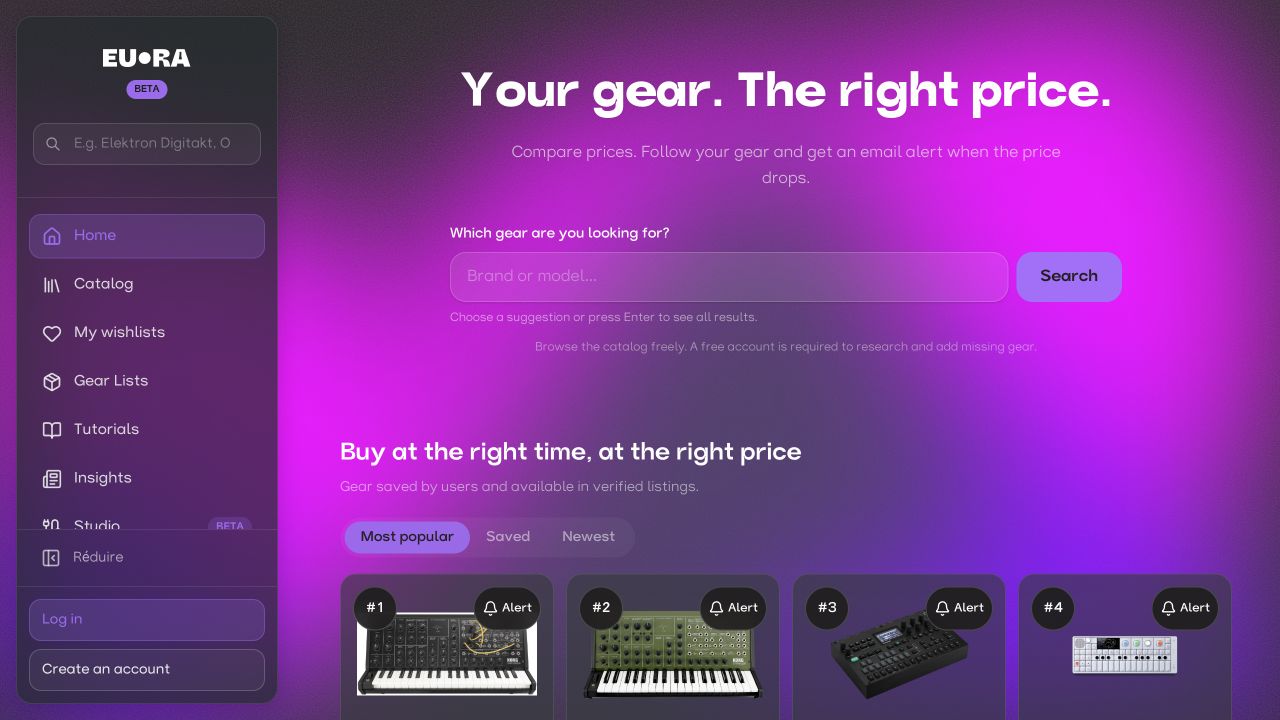
EURA.

Your gear. The right price.

Discover music gear, compare prices and build your wishlists. EURA helps you explore your next studio addition.

Explore EURA ↗
EURA music gear catalogue with synthesizers, prices and search
USB AUDIO. IN BOTH DIRECTIONS.

Connect your hardware.
Make it part of the session.

Explore Audio Bridge

One app + Receive + Send · macOS · 14-day trial

Enlarged Audio Bridge application screenshot